Currently, Fibre Channel and Gigabit Ethernet are the two choices for storage networking solutions. But according to the market, the prospect for Fibre Channel is looking bule. Even the IT professionals that run these networks have suggested abandoning the choice of this storage networking technology and jumping into the Ethernet bandwagon. Although Ethernet can certainly make a case for net new installations, does it make sense for organizations to abandon their investment for Fibre Channel and turn to an entirely new Ethernet storage networking topology? And what reason that causes this situation?
Just as Fibre Channel at the speed of 4Gb/s is poised to make its move into the data center, Ethernet is roaring back with its 10Gb/s technology. But the lure of pure speed might not be enough for Ethernet to overtake Fibre Channel--at least for now. So here comes the question: for Fibre Channel and Gigabit Ethernet, which is better?
Definition of Fibre Channel and Gigabit Ethernet
But before you get to know the advantages and disadvantages of them, the thing you must know first is that what are they? Next each definition of them will be given in this paper.

irisxu12 發表在 痞客邦 留言(0) 人氣()

SC connector
We all know that fiber optic cables can transmit pulses of light instead of electrical signals. As a result, the terminations must be much more precise. The fiber optic connector is the termination at the end of an optical fiber, enabling quicker connection and disconnection than splicing. Fiberstore offers many kinds of fiber optic connectors,and below there are some species’ descriptions of them.
ST connector was one of the first connector types widely implemented in fiber optic networking applications. Originally developed by AT&T, it stands for Straight Tip connector. ST connections use a 2.5mm ferrule with a round plastic or metal body. The connector stays in place with a "twist-on/twist-off" bayonet-style mechanism. Although extremely popular for many years, the ST connector is slowly being supplanted by smaller, denser connections in many installations.
SC connectors also use a round 2.5mm ferrule to hold a single fiber. They use a push-on/pull-off mating mechanism which is generally easier to use than the twist-style ST connector when in tight spaces. The connector body of an SC connector is square shaped, and two SC connectors are usually held together with a plastic clip (this is referred to as a duplex connection). The SC connector was developed in Japan by NTT (the Japanese telecommunications company), and is believed to be an abbreviation for Subscriber Connector, or possibly Standard Connector.
MTP is a special type of fiber optic connector. Made by US Conec, it is an improvement of the original MPO (Multi-fiber Push-On) connector designed by NTT. The MTP connector is designed to terminate several fibers-up to 12 strands-in a single ferrule. MTP connections are held in place by a push-on/pull-off latch, and can also be distinguished by a pair of metal guide pins that protrude from the front of the connector. Because of the high number of fiber strands available in a small connection, MTP assemblies are used for backbone, cross-connect, and breakout applications.

irisxu12 發表在 痞客邦 留言(0) 人氣()

10GBASE SFP Module
10 Gigabit Ethernet is a group of computer networking technologies for transmitting Ethernet frames at a rate of 10 gigabits per second. Over the years of 10 gigabit Ethernet’s existence, there have been numerous different form factors and optics types introduced, such as XFP, SFP and SFP+. Today we are going to talk about 10GBASE SFP modules which can support 10 Gigabit Ethernet.
To accommodate the ever-growing spectrum of 10 GE applications, Fiberstore currently supports several types where each technology is cost-optimized for the reach and transmission media demanded by particular 10 GE applications. As we all know, SFP can transmit signals over both singlemode fiber and multimode fiber. So next, 10 Gigabit Ethernet SFP will be introduced in these two ways.

For Multimode fiber

irisxu12 發表在 痞客邦 留言(0) 人氣()

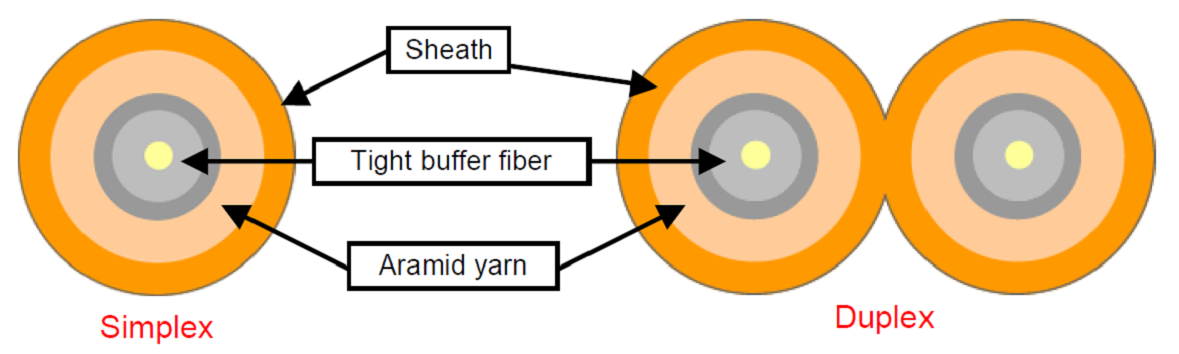
Simplex Fiber and Duplex Fiber
As we all know, fiber optic patch cable can be divided by its fiber optic mode, fiber optic structure and its connector types. So there are single-mode fiber cable and multi-mode fiber cable classified by fiber optic mode, simplex fiber cable and duplex fiber cable classified by fiber optic structure. And also, according to its connector types, fiber optic patch cable has various kinds, such as LC to LC fiber patch cable, LC to ST fiber patch cable and so on. But today, we are just going to discuss about simplex fiber cable and duplex fiber cable.
What Does Simplex or Duplex Mean?
Before we talk about simplex fiber cable and duplex fiber cable, let’s first get into the words of simplex and duplex. According to the ITU-T definition, data in a simplex channel is always in one way transmission. One end is the transmitter, while the other is the receiver which is not reversible. Simplex channels are not often used because it is not possible to send back error or control signals to the transmit end.
“Duplex” comes from “duo” that means “two”, and “plex” refers to “weave” or “fold”. In a duplex channel, data can travel in both directions simultaneously. Just like the cellphone, both parties can speak and be heard at the same time.

irisxu12 發表在 痞客邦 留言(0) 人氣()

1
Blog Stats
⚠️

成人內容提醒

本部落格內容僅限年滿十八歲者瀏覽。
若您未滿十八歲,請立即離開。

已滿十八歲者,亦請勿將內容提供給未成年人士。